


 ldakers
How to Choose a Frame for a Painting.
Do you need to highlight an artwork, a painting, a drawing or a photograph?
How do you know which frame to choose from the multitude of choices available?
Why And How to Frame a Painting?
A beautiful work of art deserves a good frame and the solutions are endless because each work is unique. Dressing a painting is a decisive choice to enhance it and protect it well.
Whether it is a painting on canvas or a work on paper, The frame should be seen as a complement to the work of art, as these two elements are inseparable from each other and always seen together.
Do you have some questions about framing?
I wanted to share my tips with you here to help you choose your frame.
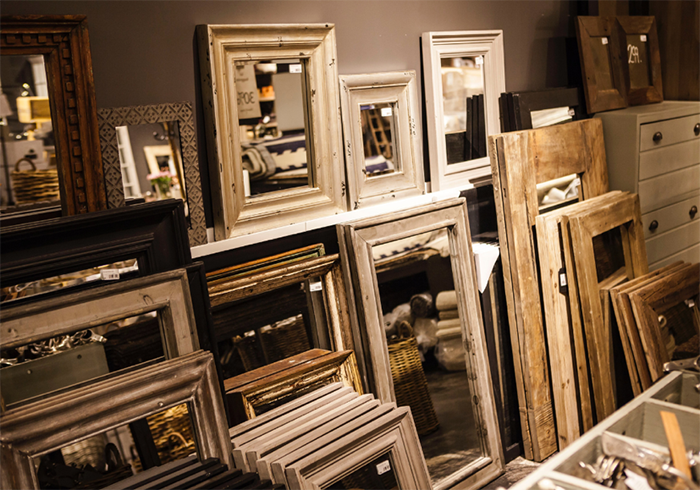
Frames shapes (Pexels)
GOOD TO KNOW: You can find a great range of watercolour paints in GreatArt store in Shoreditch (London) or on GreatArt.co.uk online shop.
Tip 1: Materials
The materials used for framing are varied.
- In raw, stained or lacquered wood (sycamore, oak, ash, maple, wenge)
- Plated aluminum (metal)
- Plastic (PVC, plexiglass)
- In plaster, waxed concrete
Wood, aluminum, plastic, it doesn’t matter what material is used, the important thing is to choose a strong and durable frame. The choice depends on the desired thinness, rigidity and lightness.
GOOD TO KNOW
In the last century, wood was still the most common choice for framing a work of art. With the advent of new materials and techniques, the colours, finishes, textures, mouldings and reliefs are unimaginable. The possibilities are endless!
Tip 2: Colours
Avoid common beginner’s mistake.
Avoid choosing the dominant colour of the painting so as not to create visual interference. The eye may then be distracted from the main subject. To avoid this, it is best to choose a colour in your painting other than the main subject/pattern.
Let’s take Amylee’s painting “Sophie, the blue giraffe” as an example.
I would not choose a frame that is the same blue as the main subject. I prefer to choose a frame colour in the same shades as the background or a natural colour such as a rough wood that is inspired by the surrounding furniture. This way, I can highlight my painting without stealing the show from the giraffe.
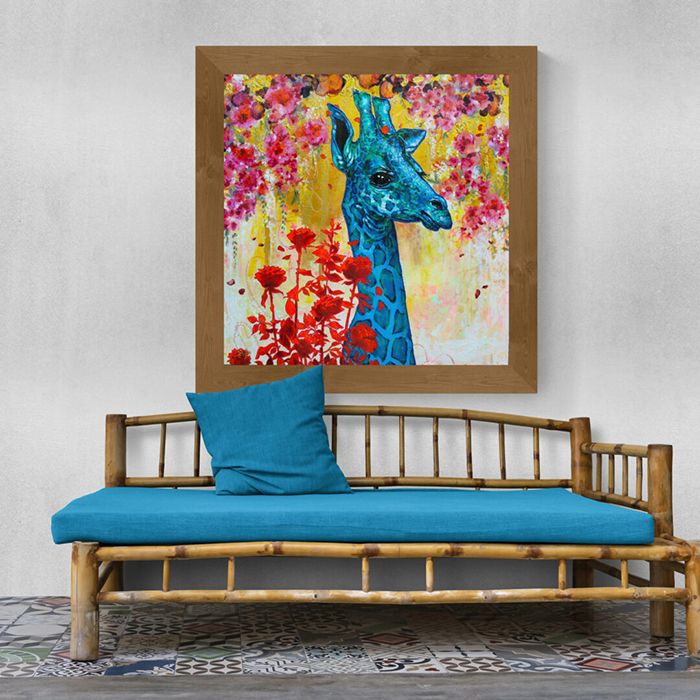
Sophie – Painting by Amylee Paris (2022)
GOOD TO KNOW
If you are unsure of your choice, choose a neutral colour or take inspiration from the surrounding furniture to be more in line with the rest of the room.
Tip 3: Styles
Choose the frame with the nature of the subject.
Refined or antique style, refined, baroque, modern, classic, the styles have evolved over the years. Art framing can take on a contemporary or classic look, all choices are possible!
Here is a non-exhaustive list that may inspire you:
- framing between two pieces of glass
- the box frame or window frame (also called 3D Box frame)
- the Floater frames
- Framing with blocked corners
- and many others…
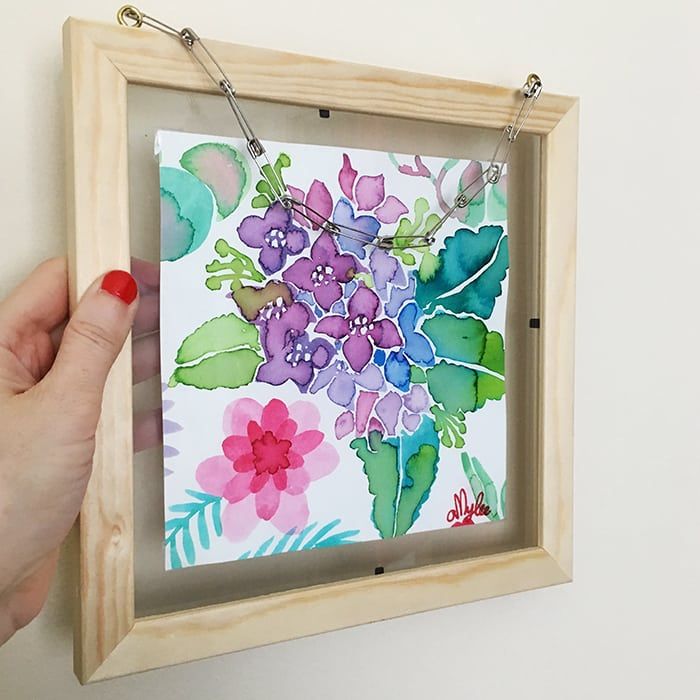
Glass spacer with hanging chain (Picture by Amylee)
GOOD TO KNOW
If your painting is in an older style you can opt for a golden, old and worked moulding.
For a contemporary or pop art painting for example or for watercolours, choose a refined frame without exaggerating the width of the moulding.
Tip 4: Mouldings
Dressing for a better view.
As with the colour, you need to find a frame that allows the work to stand out and above all to breathe. Start with something rather simple. The smaller the elements in your painting, the thinner and the frame should be. For large motifs, the frame can be thick. Don’t forget that the frame you choose is there to dress up or even enhance your work. It should be eye-catching but discreet.
- The baguette, or angle iron is the most classic finish in terms of framing. It can be enclosed in a full frame or isolated in a ready-cut mount. By playing with materials, shapes, colours and sections, the choices are constantly changing and the possibilities are endless.
- The Floater Frame is the most economical and minimalist solution for framing a large canvas in a minimal and elegant way. To form the frame, the floating frame is simply made up of four custom-cut posts. The special feature of this frame is that the painting does not touch the frame. It is thus displayed in its entirety. The uncluttered frame then disappears behind the work. It is available in different colours with or without gold edges. It is a perfect solution for exhibitions, as it is not very expensive.
- The Marie-Louise is used for framing without glass. It is placed directly between the work and the frame. Made of raw wood, painted, with gold fillet, carved or covered with gold leaf or fabric, the Marie-Louise is associated with paintings on canvas or on wooden panel.
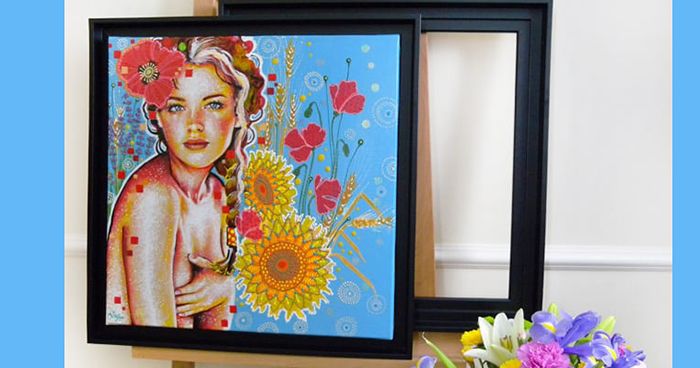
Amylee’s painting dressed in a floating frame (Picture by Amylee)
Tip 5: Glass
With or without glass, it all depends on the location chosen.
The glass should not interfere with the appreciation of the work. Above all, the glass protects the framed work and also enhances its colours.
All natural and artificial light produces electromagnetic waves which have the particularity of attacking the surface of pictorial and photographic works. Over time, these irreversible effects can lead to yellowing, discolouration or other negative effects on the pigments.
Glass provides an effective barrier between the work and external elements such as dust, moisture, smoke, or greasy particles. If the glass is not suitable, it can affect the colours or cause annoying reflections.
3 types of glass, 3 functions
- Float glass (or ordinary glass). Its surface is perfectly flat and uniform. It is a reflective glass with a thickness of 2 mm. Be careful with this choice of glass, however, as it can turn green over time.
- The “anti-reflective” glass. By treating one of the two surfaces, light reflections can be reduced. The matt finish of the glass sometimes alters the visual perception of the colours, making them appear less intense. By means of a corrosion process, the unsightly effects of reflections can be treated. On the matt surface, the incoming light can be dispersed and reflections avoided. In order not to lose the brilliance of the colours, the glass must rest directly on the image. This glass is therefore not the ideal choice for matted frames.
- Museum quality glass. The glass is almost invisible and is treated in such a way that reflections and UV rays are largely blocked. In contrast to conventional glass, museum quality anti-reflective, scratch-resistant glass does not have a corroded matt surface. It provides excellent protection for the work against fading. One of its main advantages is the faithful reproduction of colours and contrasts.
Examples of framing styles for artist’s paintings (Pexels)
Tip 6: The master key
Highlighting and giving depth.
Commonly confused with the marie-louise, the ready-cut mount serves as a margin between the work and the glass. Its thickness generally varies between 1 and 3 mm.
The functions of the matting are: to refocus the viewer’s gaze, to enhance the work while adding depth, to mask imperfections, and to isolate the work from the glass. It is frequently used to enhance photographs, watercolours, charcoal or pastel drawings and engravings. It is also possible to decorate it with simple borders or cover it with inspired motifs.
Tip 7: Where to buy a frame?
3 possibilities for framing.
Need to frame? You can buy your own equipment:
- on the Internet (on GreatArt, website specializing in distance selling of materials for painters, sculptors, engravers and illustrators)
- in specialized shops and in particular at neighbourhood framers who will offer you tailor-made frames in addition to providing you with many useful tips.
- in kit form to make your own frames. There are many tutorials online that teach you how to make a beautiful frame. A few materials such as a saw, cleats, wood glue, a frame press and paint and you can be proud to have built your own frame.
And to conclude…
A good frame will dress up a work of art magnificently, bring it prestige, make it sacred and give it much more scope.
Centuries ago, frames were used to move fresh paintings without getting your fingers dirty and to embellish paintings hung in castles or holy places. In 2022, artists have the possibility to deliver their paintings completely dry (long live acrylic paint and mediums that accelerate the drying time).
The years go by and frames are still used to allow the viewer to focus on the motif while fully appreciating the colours and the pictorial composition.
I hope that this advice has helped you to see the subject more clearly and, above all, has guided your research.
★ ★ ★ ★ ★
Content provided by Amylee Paris

The passion of Amylee, fine artist and author is to share her paintings between galleries, art collectors and her community. Amylee is also recognized as one of the most influential French artist-entrepreneurs. Since 2009 she has mentored thousands of visual artists guiding them to thriving their art career.
★ ★ ★ ★ ★
You can visit her colourful portfolio,follow her on Facebook and Instagram, or find all Amylee’s posts published in GreatArt online Magazineby clicking here!





Add comment